
Games and competitions
The ship owners should ensure the establishment of a welfare fund on board, which the vessels can manage themselves for social activities and the purchase of leisure equipment and games. The Safety Committee can appoint a welfare officer on board who will be responsible for the welfare fund and purchases. On larger ships, a ship's club can be established with responsibility for social activities and events. Here are some tips for activities, games, and competitions that are easy to organize on most vessels.
-
All ships should have a selection of variety of games onboard that are available to everyone.
-
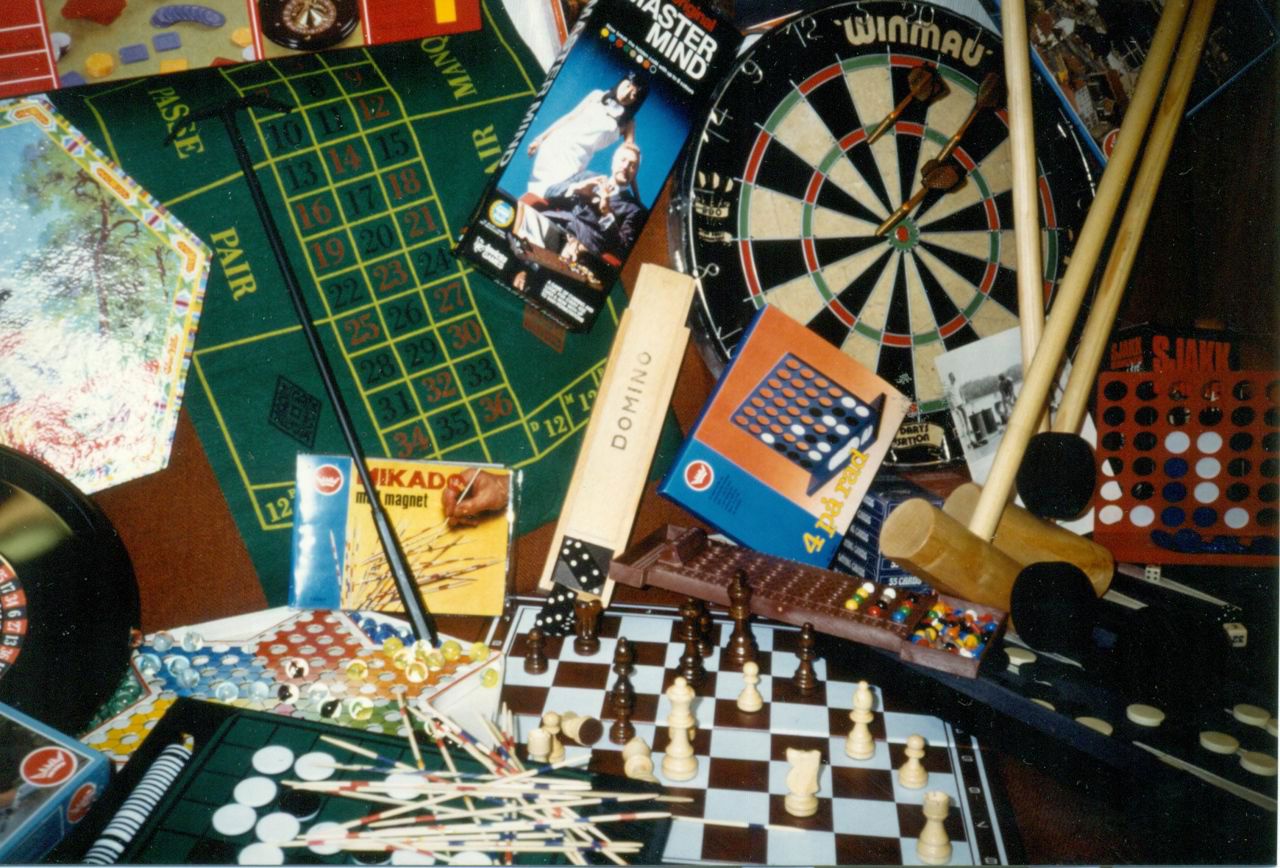
We recommend well-known classic "wordless" games that can be played with two or more participants.
Standard card decks - Uno - Chess - Chinese checkers - Checkers (Draughts) - Yatzy (Yahtzee) - Backgammon - Mikado (Pick-up sticks) - Connect Four (or Five in a Row) - Dominoes - Ludo - Mastermind - Bingo - Nine Men's Morris - Othello (Reversi) - Mahjong - Kalaha (Mancala) - Solitaire - Hex - Dice board games
P.S. Many board games are available with magnetic pieces, which is practical at sea.
-
A deck golf set and a "kubb game" are nice to have available, but there isn’t always enough time or suitable weather for such activities. However, free time often allows for a challenge in darts or at the game table from time to time.
There are many different board games/miniature versions of popular games, such as:
Foosball/soccer – Ice hockey – Air hockey – Kurong – Pucket board game – Hesherball – Table curling – Bowling board game – Shuffleboard – Table tennis – Billiards – Roulette.
These come in various sizes and qualities and are reasonably priced. There are also multi-game table sets with different "game boards" and all the necessary equipment for one table.
We recommend choosing durable versions of good quality that can withstand years of use.
-
You can create tournaments, league play, or maintain leaderboards/rankings based on most of the recreational activities and games available onboard. For example, you can crown the Chess Champion of the year, Air Hockey player, Kurong King, etc.
You can also use the onboard fitness facilities to challenge each other, such as who can row the furthest on the rowing machine, has the most kilometers on the treadmill, does the most push-ups in a row, etc.
PS! Don’t forget that you can log all your workouts in the Norwegian Maritime Authority’s sports portal "Active at sea". Here, individuals and entire ship crews can compete for prizes, honor, and glory.
-
Here you can download forms to set up and record results for team games, tournaments, and league play.
Agree in advance how the winner of a "match" will be determined. For example, should it be the person with the most goals after the agreed-upon playing time, or the first to score, say, 10 goals in table football or air hockey?
Ladder/Ranking Games
Another way to challenge each other is to simply create a “ladder” for one or more of the popular games onboard.Initially, participants’ positions on the list will be determined by when they signed up, with the most recent at the bottom.
Now, it’s all about challenging someone higher on the list to advance. If you win, you take their spot, but if you lose, you stay in your current position. The person being challenged only moves down a spot if they lose.
You can also have rules that if someone remains inactive for a long time, they will be moved to the bottom of the list.
-
Two people play against each other. After a competitive countdown like "1-2-3!", each participant should, on the count of three, form their hand into one of three symbols:
- Rock (closed fist)
- Scissors (hand with two fingers out in a scissor formation)
- Paper (open flat hand with five fingers)
How the winner is decided:
- Rock beats scissors (rock breaks scissors)
- Scissors beats paper (scissors cut paper)
- Paper beats rock (paper covers rock)
If both players choose the same symbol, it is a draw, and they play again.
Competitions
While there are no strict universal rules for rock, paper, scissors in everyday life, the game is often regulated in organized competitions to ensure fairness and structure. There are some common guidelines and rules that can be followed. It is important to agree on these rules before you start a competition or tournament on board.
- Tactics and Strategy: While rock, paper, scissors is a game based on chance, players can develop strategies to try to predict what their opponent will choose, especially in multiple rounds.
- Multiple rounds: In competitions, multiple rounds may be played to determine a winner, often in a best-of-three format or another structure to reduce the role of chance in the game.
- Time limit: In tournaments or formal games, there may be a time limit to make a choice, for example, 5-10 seconds per round.
Formal tournaments
In more organized tournaments, such as the World Rock, Paper, Scissors Championship, there may be specific rules on how choices are declared and how the games are structured (e.g., number of rounds, how to progress to the next level, etc.). There may also be requirements for how participants show their choices (e.g., using screenshots or visual aids).
Funfacts:
Did you know that hand-sign games have been known in Asia for thousands of years? The origin of rock-paper-scissors can be traced directly back to 17th-century Japan, where the game was developed in several versions after it came from China. What was common to all the variations was that players had to simultaneously choose a hand sign that could beat the opponent's. -
Since internet capacity is mostly limited onboard, there should be equipment and consoles with game software that does not require an online connection to play together.
Smartphones as Gaming Tools
Most likely, everyone has their own smartphone onboard. Access to Wi-Fi and mobile data can be limited and expensive (especially when international rates apply). However, if the internet conditions allow, the mobile phone can be used as a gaming tool for various social activities. -
Karaoke is a popular and uniting activity. Karaoke systems come in a wide range of prices, and you definitely don't need to buy the most expensive one. Just make sure that the "karaoke package" includes a karaoke player with a large selection of well-known songs, microphones, and outputs for a TV screen and speaker/amplifier.
You can also use your phone as a karaoke player, along with a speaker that has a microphone input. There are several karaoke apps available for download.
The most important thing with karaoke is to have fun together. No one should be forced to sing, but feel free to encourage others to give it a try, sing duets, or have a karaoke competition.
-
Quizzes are fun! The Norwegian quiz platform Kahoot has become an international success and is used for both learning and entertainment. You can create a Kahoot quiz for up to three participants for free. Points are awarded for correct answers and how quickly they are answered. To get the best experience, you’ll need a large screen to show the questions and answer options.
How to proceed:
Create a user and set up a Kahoot quiz in your browser or app.
- Figure out when you have time and opportunity to gather with internet access. Gather the participants in the boat's common room in front of a screen connected to the device you are using to control Kahoot.
- Ask all participants to find their own devices (smartphones, tablets, or laptops) and go to www.kahoot.it in their browsers. Enter the PIN code you received when creating your Kahoot.
- When all participants have joined, click "Start." The first question will appear, and participants answer by selecting the color option they believe is correct. Kahoot keeps track of time and scores, and the top five players are shown after each question.
PS! You can also find quiz books in our e-library for seafarers in the Bookbites app if you prefer traditional quiz competitions.
-
Geocaching is an international activity similar to orienteering, but instead of using maps and a compass, you search for posts called "caches" with a GPS. Information about all the caches is available on the website geocaching.com.
There are millions of geocaches around the world, so the chance of finding one near where you dock is pretty high.
Join the world’s largest treasure hunt with the official geocaching app.
Why not create a "challenge" onboard to find as many caches as possible within one port city or from as many different places as possible?
Of course, it’s also enjoyable to geocache together to get to know a new port city without necessarily making it a competition. Some caches are even placed in such a way that you need to cooperate to reach them.
For equipment, you’ll need at least a dedicated GPS receiver or a smartphone with GPS. Also, don’t forget a pencil or pen to sign the logbooks at the cache locations.
