New Regulations on safety in passenger spaces
The Norwegian Maritime Authority (NMA) has laid down new Regulations on safety in passenger spaces.
| Date: | 17 December 2021 |
|---|---|
| Series | RSR |
| Number | RSR 16 - 2021 |
| Case number | 2021/10470-32 |
| Attachment | Download as PDF |
The proposal was circulated for comments from 9 February until 9 June 2021, and we have received 15 consultative statements. Most of these statements expressed support for the new Regulations, which prioritise the protection of life, health, property and the environment over comfort requirements. Public purchasers of transport services indicated a need for more time to implement the rules. The implementation date has been postponed to 1 January 2022 from the initially proposed date of 1 July 2021. The NMA has had discussions with the purchasers at Public Transport Norway (the Norwegian Association of Public Transport Authorities) to ensure a smooth transition process. Other consultative statements focused on technical aspects. All consultative statements, along with the evaluations and conclusions of the NMA, are included in the attached consultation matrix.
The new Regulations replace the Regulations of 2 October 1972 No. 4, Circular RSV 10-2014 and Circular RSV 2-2020.
Legal basis – the Ship Safety and Security Act
The new Regulations are founded upon the Act of 16 February 2007 No. 9 relating to ship safety and security (Ship Safety and Security Act) sections 9, 11 and 45.
Comments to the individual sections
The Regulations of 4 November 1981 No. 3793 on trade areas provide the definitions of "domestic voyages", "small coasting", "foreign voyages" and "international voyages", cf. the Trade Area Regulations section 1.
To section 1 Scope of applictaion
The Regulations apply to ships that are certified to carry passengers. "Passengers" are defined as any person on board except for the master, other persons working on board and children under the age of one year. "Passengers" in this context also include persons visiting the ship while it is berthed in port. Persons working on board at the service of the ship while the ship is moored, are not considered passengers.
The Regulations include requirements that apply both while the ship is underway, and while it is in port with passengers on board.
The requirements of the Regulations supplement the requirements of the regulations on construction that are applicable to the ship, and should help lay down a common safety stabdard for all types of passenger ships.
To section 2 Ships constructed before 1 January 2022
The exemption provision in section 2 is applicable to Norwegian ships that obtained certification prior to entry into force of the Regulations. Additionally, it extends to Norwegian passenger ships that had their keel laid or were at a similar stage of construction before the Regulations came into force. This exemption does not encompass ships registered in the Norwegian International Ship Register (NIS) or the Norwegian Ordinary Ship Register (NOR), nor does it include ships that were not previously classified as passenger ships. Nevertheless, it is possible to seek exemption when necessary under section 18. In evaluation exemption requests, the focus will be on ensuring that the proposed solutions are at least as effective as those found on a Norwegian passenger ship of similar age, size and intended application.
Second paragraph:
The purpose of this paragraph is to ensure that existing ships undergoing conversion are upgraded to meet a new safety standard to the greatest extent possible. The intent is not to hinder the conversion of older ships, hence the exemption provided for structural requirements in section 4. The Norwegian Boat Association HRF suggested that section 5 first paragraph should also be included in the exemption. The NMA assumes that this issue primarily affects small high-speed craft and therefore refers to the exemption provision.
Third paragraph:
When a company intends to alter the number of passengers on a ship, the new requirements for capacity in accommodation spaces, seating and standing places become applicable. If this change leads to a conversion or modification, the provisions of the second paragraph will also apply.
To section 3 Ships of less than 15 metres in length
Vessels of less than 15 metres complying with the Nordic Boat Standard are exempt from adhering to the requirements in sections 4–13. Full compliance with the chosen legislation is a prerequisite for establishing a common standard.
To section 4 Construction requirements
First paragraph:
All areas accessible to passengers during normal operation are classified as passenger spaces. This includes spaces such as restaurants, cinemas and tender lobbies, even if they are occasionally closed off, since they are primarily intended for passengers. Areas like wheelhouses are not considered passenger spaces, even if the shipping company invites passengers for a tour.
The main requirement stipulated in the provisions is that all passenger spaces must be located and designated to ensure proper protection of life and health when used as intended. These Regulations do not provide detailed requirements for all types of passenger spaces. However, it is the responsibility of the shipping company to carry out their own risk assessments based on the intended use. Please refer to sections 9 and 11 of the Ship Safety and Security Act.
Passenger spaces must be protected against undue noise and emissions from other parts of the ship. The limit values in the Regulations of 1 January 2005 No. 8 on working environment, etc. on board ship serve as guidance for the determination of undue noise. “Emissions” should be interpreted broadly and could, for example, include gases, odours, polluted air, exhaust fumes, etc.
Second paragraph:
Passengers should not have to traverse parts of the ship that are not designated pursuant to the provisions of the new Regulations. Therefore, it is a requirement that the passengers directly access passenger spaces upon embarkation, and that these passenger spaces on board are connected. For instance, it is prohibited to have a design that necessitates passengers to traverse crew areas in order to move between two passenger spaces.
Third paragraph:
This continues section 13 first paragraph of the previous Regulations. Additionally, a specification regarding the application of this provision on ships without collision bulkheads has been included.
Fourth paragraph:
The floor of passenger spaces shall be situated above the deepest load line of the ship.When passenger spaces are located above the water line, there is enhanced safety in the event of accidents such as grounding or flooding. This represents a stricter standard compared to the previous Regulations, where one deck could be located below the deepest load line. The requirement now mirrors that of the Regulations of 21 April 2017 No. 515 on accommodation, recreational facilities, food and catering on ships, specifically in section 8 fourth paragraph. This inclusion is justified as it is equally applicable to passenger spaces as it is to crew spaces.
The smallest vessels have the option to adhere to the Nordic Boat Standard instead of this requirement, cf. section 3.
Fifth paragraph:
The ceiling height had been increased by 30 mm compared to the existing Regulationst. This adjustment aims to align the rules with the requirements of the Maritime Labour Convention (MLC), which are applicable to other parts of the ship.
Areas where the ceiling height may be reduced include spaces with lifejacket containers located in the ceiling above seats, among others. Ceiling heights in stairways must be measured as shown in figure 1. Figure 1 also illusrates the necessary ceiling height above starirlifts, cf. section 5.
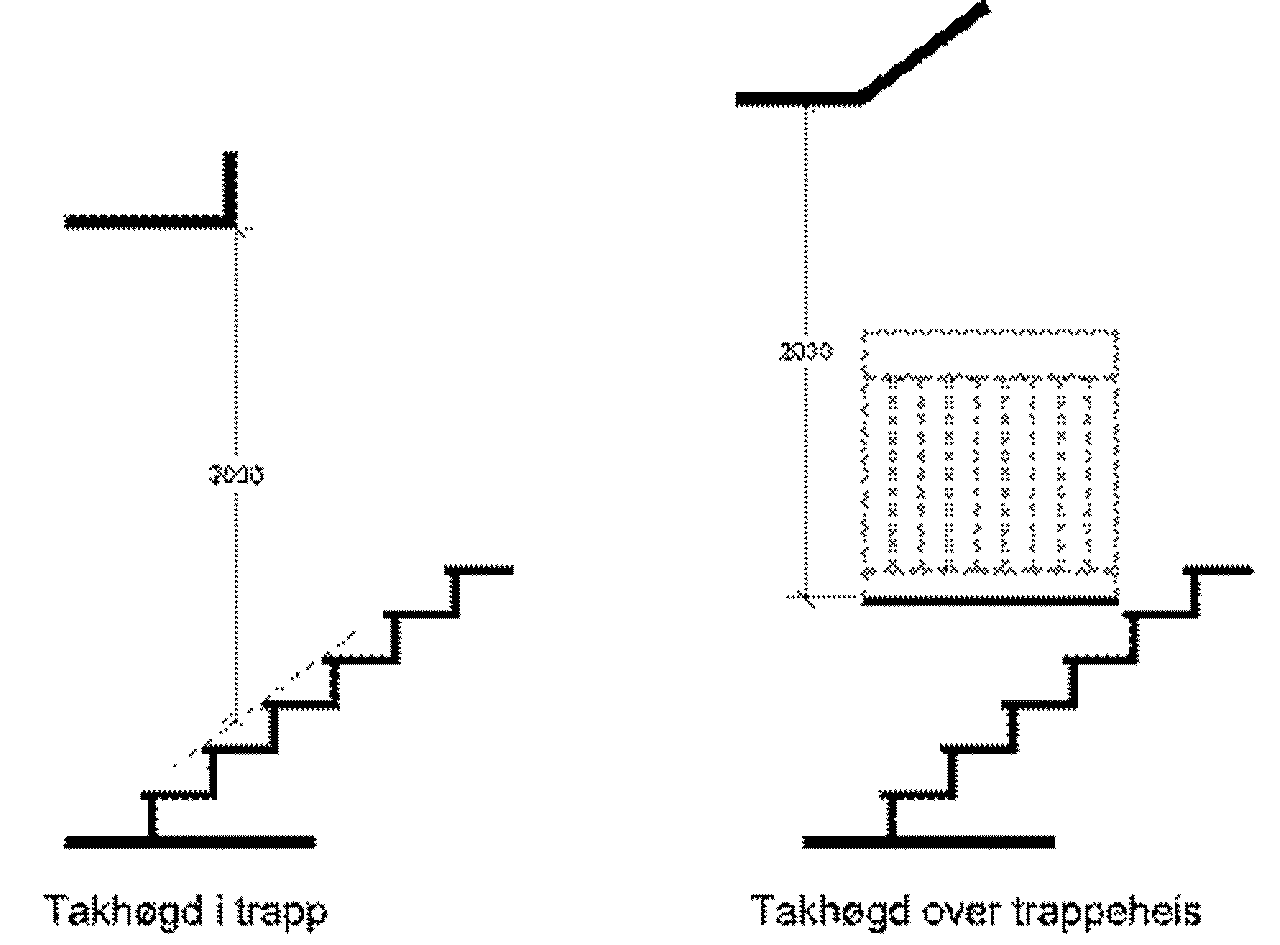
Figure 1
Sixth paragraph
Doorways shall be constructed so that the top of the doorway is at least 2000 mm above the deck/floor in front of the door. The measurement should be taken from the deck/floor, even if the door has coaming (figure 2, left-hand side). In cases where a ramp has been installed, the measurement should be taken from the top of the ramp (figure 2, right-hand side).
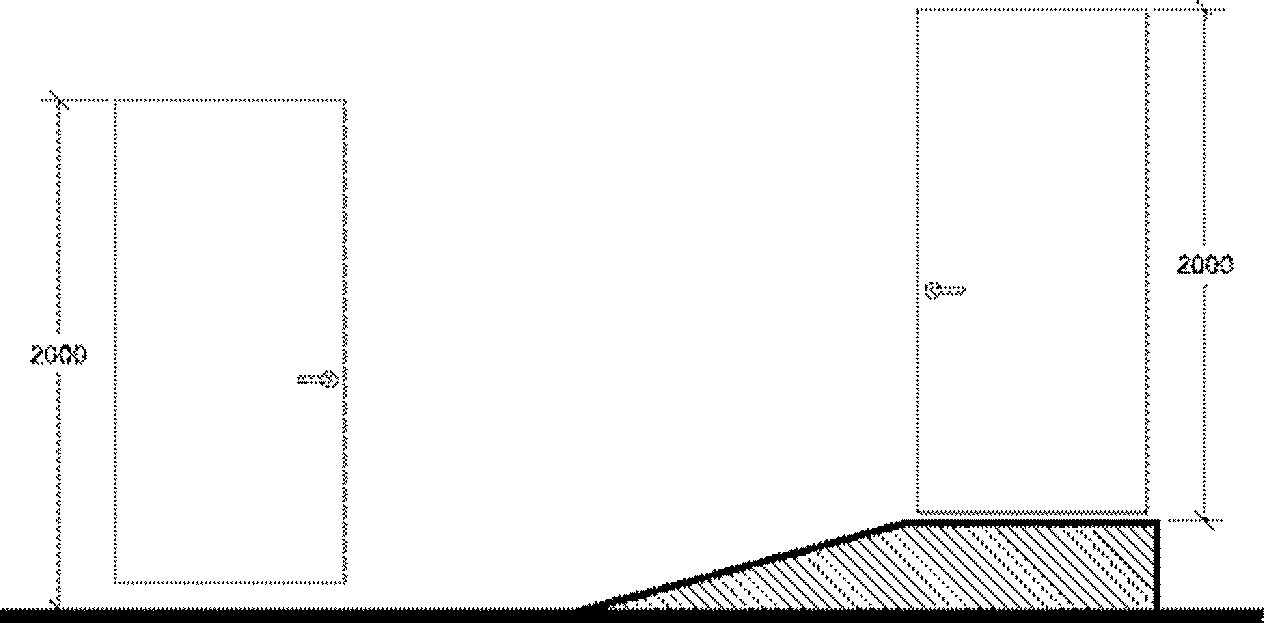
Figure 2
Seventh paragraph
The provision concerning crush hazard in doors has been established as a functional requirement, with the objective that the industry itself will develop effective solutions for mitigating this issue. It is imperative for the NMA that these solutions effectively reduce the crush hazard.
Numerous NMA regulations specify requirements for closing mechanisms for certain doors, such as fire doors, waterproof and weather-tight doors. The shipping company must implement measures to minimise the crush hazard to the greatest extent possible while ensure the functionality of the door. If the risk cannot be reduced sufficiently by the physical measures, signs, in addition to other measures, or similar marking to draw attention to the hazard must be provided. However, the NMA does not consider signs and marking alone as adequate to fulfil this requirement.
Eight paragraph
There were several comments regarding the term "non-slip", noting that it could be interpreted differently. However, no specific suggestions were provided. The intention of this provision is to ensure that floors and decks are reasonably safe under normal conditions. Indoors, this can be achieved by using approved flooring materials, carpeting, etc., while outdoors, the requirement can be met by using anti-skid paint or similar. In many cases, operational measures such as maintaining dry indoor floors and keeping outdoor surfaces free from ice may be necessary. The requirement for skid-proofing applies to all surfaces where passengers will walk, including stairway steps and ramps. The Regulations explicitly state this requirement also applies to stairway steps and ramps.
To section 5 Stairways
First paragraph
Stairways in passenger spaces must be designed according to the formula: 2 x riser + 1 x tread = 620 mm ± 20 mm. This formula applies to all stairways with passenger spaces, except for escape routes that are not used on a daily basis. The definitions of "thread width" and "riser" are illustrated in figure 3. Additionally, it is important to clarify that a "flight" refers to a consecutive series of steps, while a "stairway" is one or more "flights" and landings that connect two or more decks or differend levels of a single deck.
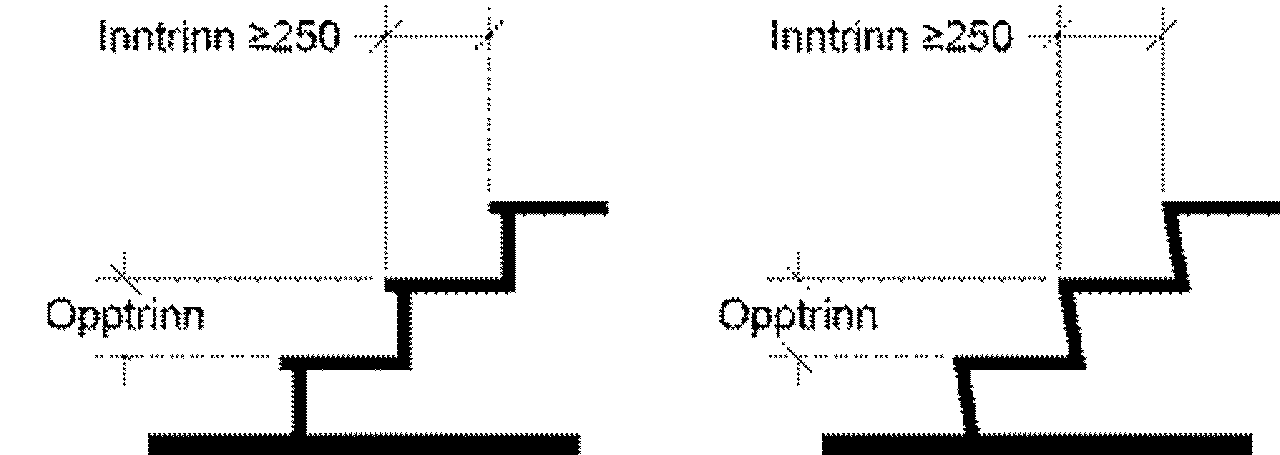
Figure 3
The entire stairway shall have an equal rise. This means that all steps should have the same riser height, and that all steps, excluding landings, should have the same tread width.
In addition to the stipulations outlined in this section, it is important to comply with requirements from other regulations. These include specifications regarding the width of steps, landings, handrails on both sides of the stairway, the use of contrasting colours, tactile markings, etc.
Second paragraph:
The requirement aims to prevent young children from falling though openings between steps. Numerous comments were received regarding this new provision, with many proposing to increase the dimension from 100 mm to 150 mm. The NMA believes this would not ensure sufficient safety for the youngest children and maintains the proposal to harmonise the rules for ships with the requirements applicable to communal buildings on land.
Third paragraph:
Lifting platforms and stairlifts may not replace an approved passenger lift on ships where this is required.
Fourth paragraph:
Stairlifts are considered obstacles in the stairways where they are installed and therefore may not be installed in stairways that are part of the escape routes on board.
To section 6 Railings
The railing requirement can be met by providing bulwark of adequate height and openings. Alternatively, a combination of bulwarks and railings can be employed to fulfil this requirement.
First paragraph
The requirements apply to passenger spaces, which can be internal or external. These requirements are applicable to both stairways and other areas with a level difference of more than 500 mm.
Second paragraph
Railings in internal and external passenger spaces must be constructed to prevent any passenger from climbing on them. See example in figure 4. An example of a common railing design is illustrated in figure 4. The shipping company may select alternative designs as long as they meet the specified requirements.
Third paragraph
The minimum height of railings in passenger spaces shall be 1,100 mm. This requirement also applies in stairways. To meet both the height requirement for railings and the requirement outlined in MSC.1/Circ. 735, which stipulates that handrails should be fixed at a height of 850 mm above the thread, the handrail must typically be installed on the inside of the railing, as shown in figure 5.
Fourth paragraph
No openings shall exceed 100 mm up to a height of 900 mm, meaning that no openings can be longer or wider than 100 mm, as shown in figure 4. The purpose of this provision is to prevent small children from passing through any opening.
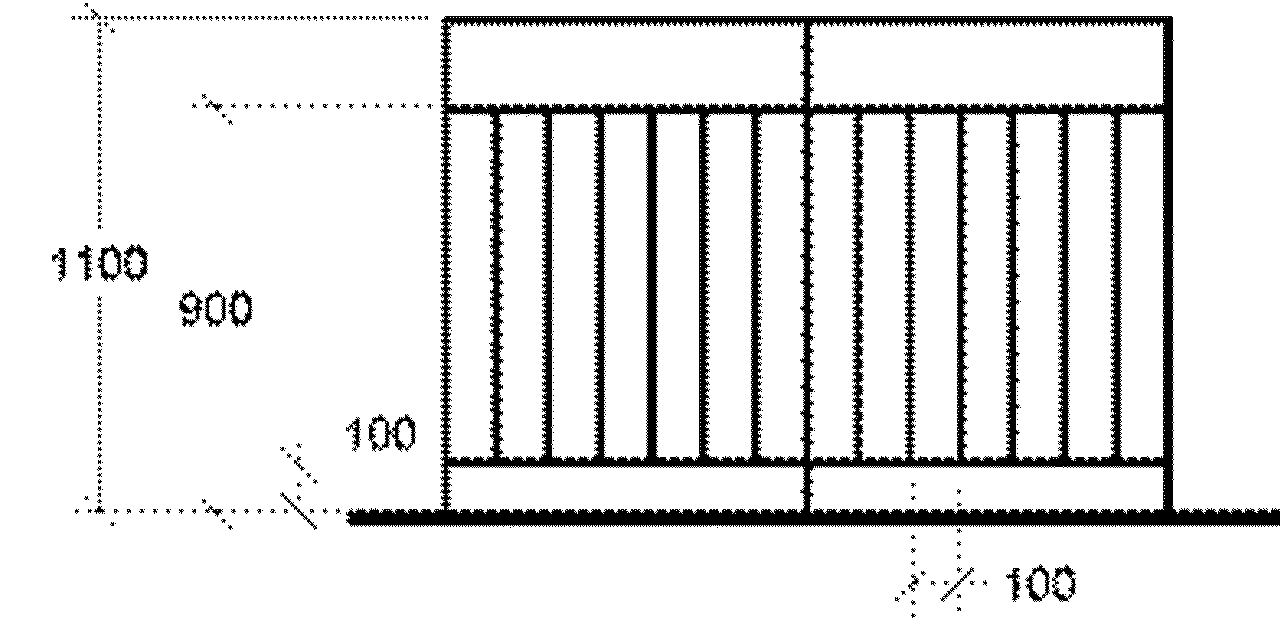
Figure 4
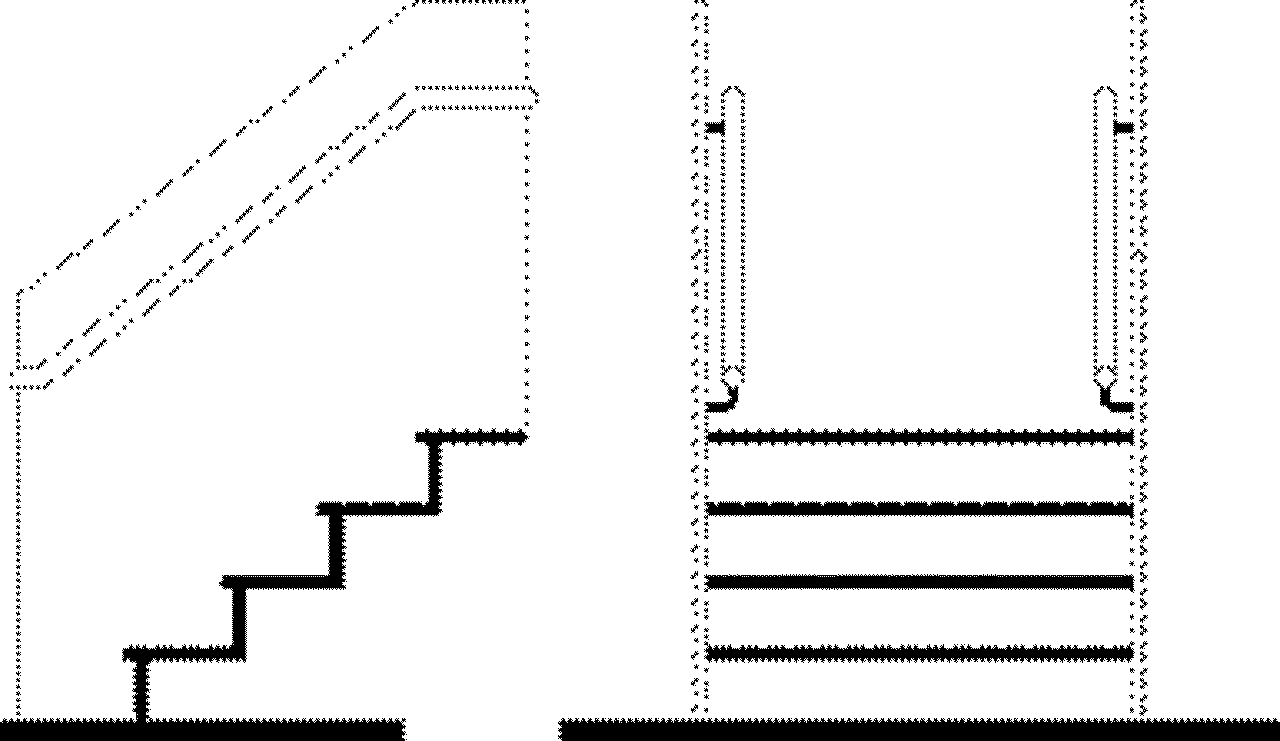
Figure 5
Fifth paragraph
Freeing ports, holes and similar openings in railings shall be secured so that no opening is larger than 100 mm. The shipping company may address this by either confining passenger spaces to areas with railings so that the freeing ports and holes are not part of the passenger spaces, or by implementing other measures such as grating or poles to reduce the openings to meet the requirement. Barriers must be designed in a way that does not compromise the function or size of the freeing ports or holes where these are regulated by requirements in other Regulations.
It is important to note that this requirement applies both when the ship is underwya and when it is moored, as long as there are passengers on board.
Sixth paragraph:
Portar i rekkverk skal oppfylle same krav som rekkverk. Portane skal ha utforming og låsemekanisme som er utforma slik at porten ikkje kan opnast utilsikta. Mekanismen bør vere slik at det krevst fleire samtidige handlingar, som til dømes å trykke inn ein knapp samstundes med at ein vrir på eit handtak eller liknande.
To section 7 Ventilation and heating
This provision contains basic functional requirements aimed at ensuring satisfactory temperature and air quality in the passenger spaces.
To section 8 Lighting
The minimum requirement for averagte luminous intensity is 150 lux, but intensities above 150 lux might be required. For instance, according to MSC.1/Circ. 735, stairway ligthing should prioritise optimum safety. The Norwegian Association of the Blind and Partially Sighted recommends that all rooms in public buildings should have a minimum luminous intensity of 200 lux, and 300–500 lux in meeting rooms, receptions and other areas where reading or writing is performed1.
Ligthing that could affect the navigation of ship includes any lighting that diminishes the visibility of lanterns and any lighting that may impair the night vision of those on navigational watch. Passenger spaces, including car decks, lacking sufficient light (150 lux) must be cordened off when it is dark.
To secrtion 9 Accommodation spaces
First paragraph:
There shall be internal passenger spaces with accommodation areas capable of accommodating all passengers. Internal means that the accommodation space must be located in a superstructure or below deck. Accommodation spaces include lounges, restaurants, shops and other communal areas accessible to passengers throughout the journey. On passenger ships with cabins, the cabins may also be included. Sanitary rooms and spaces open for limited periods, such as cinemas, car decks and tender lobbies, are excluded.
As a general rule, there must be seats for all passengers.
The Norwegian Shipowners' Association noted that on larger ships, some of the required seats are loose chairs in restaurants, suggesting that the Regulations should support the continuation of this practice. In response, the NMA has amended the provision to allow for 20% of the required seats to be loose chairs. This number aligns with the requirement for ships on international voyages with a journey time of less than 24 hours, as specified in the Regulations of 2 October 1972 No. 4 concerning calculation of number of passengers and concerning passenger accommodation, etc. section 7. Loose chairs must not be stowed away and must remain available to passengers throughout the journey.
When the journey time is less than 30 minutes, the shipowner is responsible for determining the number of seats. Those without a seat must have a standing place in an internal accommodation space. We recommend installing a minimum number of seats for persons with disabilities and considering seats for all passengers on smaller ships operating in areas with rough sea conditions.
Second paragraph
As a minimum requirement, ro-ro- passenger ships must provide seats and/or standing places for half of the passengers. When the journey time is less than 30 minutes, the shipowner will have the discertion to determine the ratio of standing places to seats. When the journey time is more than 30 minutes, there must be setas for at least half of the certified number of passengers the ship is certified to carry.
Third paragraph
On high-speed craft, all seats must be fixed. If the collision acceleration, according to the International Code of Safety for High-Speed Craft (HSC Code), is 3 or more, the seats must face forwards or backwards.
Fourth and fifth paragraphs
Figure 6 illustrates the minimum required distances between the seat and other parts of the ship. The width of 500 mm for each seat includes any armrests or minor spaces between the seats.
Figure 6
Sixth paragraph
On vessels where standing places are required, they must be situated in internal accommodation spaces, as outlined in the first and second paragraphs. Areas designed for restrooms and similar facilities are nor included, nor are escape route areas amd walkways between seats. Small areas unsuitable for standing places are also exempt.
Standing places shall not include the area 300 mm in front of the edge of a seat or loose chairs, which shall be reserved for leg room for the person sitting in the seat.
Handles or similar devices must be provided for passengers to hold onto. These holding devices must be placed at various heights suitable for both children and adults, and must be of appropriate size for their intended purpose.
To section 10 Cabins
This provision primarily continues previous regulations, but has been slightly simplified.
To section 11 Toilet and wet rooms
As a general rule, each ship must have at least one passenger toilet in addition to toilets for the crew. Any additional capacity is determined by the service level the shipping company wishes to provide to their passengers and is not directly related to safety.
In the circulated proposal, there was no exemption for ships with a journey time of less than 15 minutes. However, this exemption has been included following suggestions form the Norwegian boat association HRF and NHO Sjøfart (employers' association and trade association witing shipping).
The toilet mentioned in the first paragraph can be the same as the toilet required on ships with universal design.
The second paragraph applies to toilets and all other wet rooms on board
To section 12 Hospital accommodation, etc.
Ships that are required to have hospital accommodation pursuant to the Regulations of 21 April 2017 No. 515 on accommodation, recreational facilities, food and catering on ships section 12 may have combined hospital accommodation for passengers and crew. When determining capacity, the total number of persons on board must be considered.
First paragraph:
This paragraph applies to all passenger ships regardless of trade area and size. A plan shall be established for the transportation and isolation of sick persons. For small vessels in regular service, the plan may entail transporting sick persons needing isolation on separate journeys without other passengers on board. The plan must include instructions for cleaning and disinfection.
Ships engaged on domestic voyages are typically in proximity to land-based health services, eliminating the current necessity for dedicated hospital accommodation in trade area Small coasting. The shipping company must conduct an assessment and organise the ship to ensure responsible provision of necessary medical treatment until more speacialised treatment is available, often upon reaching port. For some ships, creating dedicated hospital accommodation for domestic voyages may be a suitable solution.
The shipping company must be prepared to present documentation showing the evaluations upon which the selected solution is based.
Second paragraph:
Ships designated for use as ambulances are those incorporated into Norway's emergency medical preparedness in Norway, cf. Regulations of 20 March 2015 No. 231 on the requirements for organisation of municipal emergency medical services, ambulance services, emergency medical servicesm etc. These ships must include dedicated rooms for the transportation and treatment of sick persons, even when engaged on domestic voyages. Additionally, ambulance vessels must comply with requirements for passenger space, seating, etc. specified in these Regulations.
Third paragraph:
All ships engaged on foreign voyages shall have dedicated hospital accommodation solely designated for this purpose. There are no specific requirements for the hospital accommodation due to potential significant variations among ships. However, the shipping company is still required to document that the space has been constructed in accordance with a recognised standard, such as those referred to in MSC.1/Circ. 1129.
Direct communication between onboard medical personnel and onshode medical personnel during treatment may be crucial for the proper and efficient care of sick abd injured persons. In Norway, Radio Medico currently provides telemedical assistance.
Fourth paragraph:
The shipping company must assess the required capacity for each ship to ensure hygienically responsible handling and the prevention of disease spreading. This aligns with the statutory objective of the Ship Safety and Security Act, cf. section 1.
Ships engaged on domestic journeys are subject to the Regulations of 3 April 1998 No. 327 on the transport, handling and packaging of corpses, and funeral.
To section 13 Prison cell
All passenger ships engaged on foreign voyages shall have a prison cell. The prison cell can be used to maintain peace and order and prevent or protect the ship from illegal acts, cf. the Ship Safety and Security Act, chapter 6. When force is employed, this must be executed in a way that safeguards the safety of the prisoner. Detailed requirements regarding the design and use of prison cells on board ships are found in the Regulations of 6 August 2009 No. 1032 on the use of prison cells on board Norwegian ships.
Section 14 Steering position in passenger spaces
Sections 14 and 15 have been intercharged compared to the circulated proposal. This is due to the amendment to section 2 concerning which the applicable sections for existing ships.
Certain small passenger ships have a combined wheelhouse and passenger lounge. This type of solution could provide impractical, and it is important that the shipping company facilitates so that the passengers are not hindering safe navigation. Consequently, seating and standing areas must be arranged in a way that does not obstruct or compromise the visibility of the master.
To section 15 The passengers' luggage
Following a comment from the Norwegian Shipowners' Association, this provision has been made applicable to existing ships, cf. section 2. The first paragraph contains requirements carried over from previous regulations.The second and third paragraps are "can" provisions that existing ships should be able to implement.
"Dangerous luggage" refers to consumer packaged goods classified as dangerous goods according to the IMDG Code (products with a UN number). Examples include a can of petrol, a gas container for a barbeque, fireworks or hand weapon ammunition available to the public. Dangerous luggage listed in the appendix is not classified as dangerous goods.
"Small electric vehicles" include electric bicycles, electric scooters, personal transporters, hover boards, etc., as defined by the Norwegian Public Roads Administration2.
Aids for persons with disabilities or medical equipment required by the passengers during the journey are not classified as luggage. Examples include electrical wheelchairs or oxygen apparatus. Such aids are permitted in the passenger spaces.
First paragraph:
There shall be adequate space for luggage so that the luggage is not obstructing escape routes. Shelves must be designated to prevent luggage from falling out and obstructing or causing harm to persons or property. Additionally, measures should be taken to protect luggage from theft.
Second paragraph:
The wording of the second paragraph has been revised based on feedback from NHO Sjøfart (employers' association and trade association within shipping) and dialogue with SAMS Norway, the organisation behind the ZAWAS prosject (Zero-emission Automated/autonomous Water Shuttles).SAMS Norway did not submit any comments.
The updated wording allows for the storage og small electric vehicles on closed car decks since they are not considered "internal accommodation spaces", as explained in section 9. This formulation also permits passengers to bring small electic vehicles on board, such as on small city ferries, as long as they surpervise the vehicle throughout the entire journey. Storing small electric vehicles on luggage shelves or other unattended areas is not permitted.
NHO Sjøfart also raised concerns regarding the last part of the second paragraph on charging. The wording has been changed to permit charging on ro-ro decks if the ship is equipped with this facility.
The requirement that luggage must not obstruct escape routes also applies to small electruc vehicles. The NMA repeats the recommendation that the travellers should be able to protect their property against theft, as this is important for the effectiveness of the provision. Furthermore, the ship should be designed in a way thet allows electric vehicles to be positioned to minimise exposure to sea spray as much as possible
Third paragraph:
Passengers are required to inform the crew if they are carrying dangerous luggage, cf. the Norwegian Maritime Code of 24 June 1994 No. 39 section 409. The shipping company is obliged to inform passengers about what is considered dangerous luggage. This information can for example be provided through easily visible posters or included when purchasing a ticket via a mobile application.
The Regulations include an appendix containing a list of goods that can be transported as dangerous luggage on passenger ships engaged on domestic journeys and training requirements for personnel handling and assessing dangerous luggage are also outlined in the appendix. While the list is primarily intended for individual transport needs, it is not limited to induviduals. Businesses may also use the exemption provision, provided that the type and amount of goods fall within the limits specified in the appendix. Goods not listed in the appendix or larger containers/units must be transported as dangerous goods pursuant to the Regulations of 1 July 2014 No. 944 on dangerous goods on Norwegian ships.
The list in the appendix was created based on industry needs, particularly from the high-speed craft industry and is exhaustive. The Norwegian boat association HRF suggested that the list be revised within 18 months of implementation. The NMA invites the industry to register feedback on the use of the provision and forward it to us.
The cabinet for storage of for instance flammable liquids shall be regarded as a separate space, and the requirements for insulation applicable to the ship must be met. The cabinet must be categorised as a storeroom containing flammable liquids (14)3. For ships built after the 2000 HSC Code, cabinets shall be categorised as spaces for transporting dangerous cargo (A).
To section 16 Requirements for operation and maintenance
The NMA would like to emphasise that the requirements of this provision apply at all times when there are passengers on board, including when the ship is berthed.
First paragraph:
All furnishings and other loose objects must be capable of being secured to prevent harm to persons. The securing measures must be designed considering the worst possible conditions and the size and weigth of the objects. There is no requirement for all objects to be secured at all times. As an example, light chairs in restaurants may remain loose, but must be fastened by the crew when needed. On smaller ships, especially high-speed craft, aøø furniture should be fastened at all times.
Seond paragraph:
Maintenance needs often arise while passengers are on board. To prevent serious accidents related to maintenance work, the area must be secured using signs, barriers or guards.
Third paragraph:
Doors, deck, stairs and ramps must be kept non-skid. This entails ensuring that these areas are clean and fee from ice. Internal floors must be kept dry.
Fourth paragraph:
Machinery or technical equipment may pose a hazard if operated incorrectly or unintentionally. The term "machinery and technical equipment" encompasses mooring winches, loading and unloading devices, hanging decks, bow visors and trapdoors on car ferries. Passengers should be restricted from accessing areas where such equipment is located to the greatest extent possible. In cases where access cannot be fully prevented, there must be established routines for the responsible protection of the area.
Fifth paragraph:
Passengers are permitted to tour areas outside of designated passenger spaces, such as the wheelhouse or machinery space. Such tours must be conducted under the supervision of onboard personnel, and the number of passengers must adhere to safety regulations. Large gatherings of passengers outside of designated passenger spaces should be avoided, since these areas are not equipped with escape routes for many people.
To section 17 Documentation
This provision continues previous requirements in line with current practice.
To section 18 Exemptions
As a general rule, full compliance with the requirements of the Regulations is expected. However, this rule allows for individual exemptions after a thorough assessment if specific conditions are met.
To section 19 Entry into force
The Regulations enter into force 1 January 2022, and at the same time the Regulations of 2 October 1972 No. 4 on calculation of the number of passengers and concerning passenger accommodation, etc. are repealed. The consultation letter suggested a possible implementation date of 1 July 2021. Feedback from various stakeholders, including NHO Sjøfart, recommended 1 January 2022, citing insufficient time for preparation. Det einaste konkrete innspelet var NHO Sjøfart, som føreslo 1. januar 2022.
Additionally, the Norwegian Public Roads Administration inquired about transitional arrangements for national ferries already announced or signed to commence after the implementation date. After thorough evaluation and discussios, the NMA determined that such transitional arrangements would not be feasible.
Footnotes
- https://www.blindeforbundet.no/universell-utforming/norges-blindeforbunds-krav-til-publikumsbygg#Belysning
- https://www.vegvesen.no/kjoretoy/Eie+og+vedlikeholde/elkjoretoy/sma-elektriske-kjoretoy
- cf. SOLAS chapter II-2 Rule 9 and SOLAS Chapter II-2 Part B Regulation 4