Guidelines on training requirements for persons working with electrical installations and equipment in hazardous spaces on board ships
The Norwegian Maritime Authority (NMA) uses this Circular to provide guidelines on training requirements on board ships. These guidelines are based on the requirement for training outlined in the Regulations of 22 December 2011 No. 1523 on qualifications and certificates for seafarers (Qualification Regulations) Appendix IX and the Regulations of 1 January 2005 No. 8 on the working environment, health and safety of persons working on board ship (ASH Regulations) section 2-6, specifically for those who will be working with electrical installations and equipment in hazardous spaces.
| Date: | 18 January 2022 |
|---|---|
| Series | RSV |
| Number | RSV 1 - 2022 |
| Case number | 2021/166406 OKD |
| Attachment | Download as PDF |
Background
Pursuant to the Act of 16 February 2007 No. 9 relating to ship safety and security (Ship Safety and Security Act) "[a] ship shall be so operated and maintained that it according to its purpose and trade area provides for satisfactory safety concerning life, health, property and the environment". Furthermore, it is stipulated in the Ship Safety and Security Act section 22 that "[t]he work on board shall be arranged and carried out so as to safeguard life, health and working environment. In the arrangement if work, due regard shall be paid to the individual person's qualifications to undertake the work in a safe and proper manner."
The Qualification Regulations Appendix IX includes STCW table A-V/3-2 (specification of minimum standard of competence of advanced training for ships using fuel with a flashpoint of less than 60 °C) which requires electrical safety training according to IEC 60079-17.
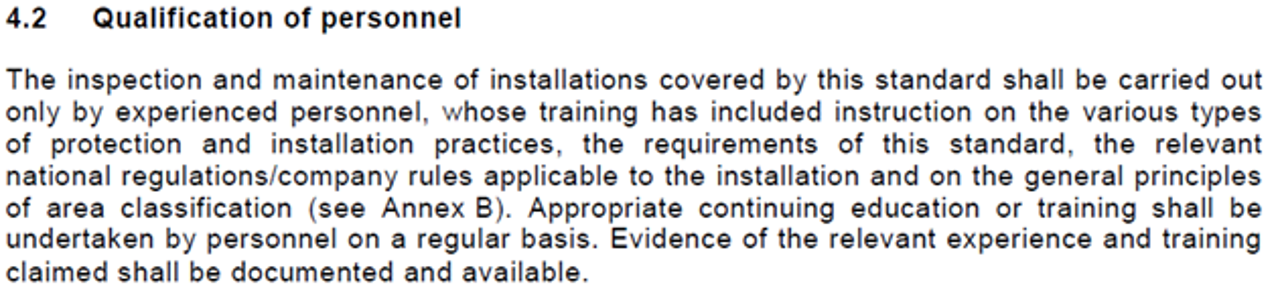
Source: IEC 60079-17:2013 4.2 (Qualification of personnel)
Providing training to persons working on board ships is important to ensure that they carry out their work in a safe and proper manner.
The scope of the electrical safety training based on IEC 60079-17 pursuant to the Qualification Regulations Appendix IX, is described in more detail in the Regulations on ship using fuel with a flashpoint of less than 60 °C section. The Regulatory requirement reflects IEC 60079-17 paragraph 4.2 (Qualification of personnel) and specifies that personnel carrying out inspections and maintenance of electrical installations in hazardous spaces shall be qualified pursuant to the mentioned IEC standard.
Since hazardous spaces may be found on board vessels other than those using fuels with a flashpoint of less than 60 °C, the NMA recognises a broader need for additional guiding on training in accordance with IEC 60079-17 concerning the Qualification Regulations Appendix IX (STCW table A-V/3-2) and requirements for training pursuant to the Regulations on the working environment, health and safety of persons working on board ship (HSE Regulations) section 2-6.
Measures
The HSE Regulations section 2-6 require that persons working on board must undergo necessary training to be able to carry out their work in a safe and propoer manner. Furthermore, they must receive training before being granted access to areas posing a significant or serious risk.
For ships with hazardous spaces on board, the training requirements applicable are those found in the Qualification Regulations Appendix IX and the HSE Regulations section 2-6. These training requirements apply to the person responsible for managing or performing
- tasks related to the operation of electrical equipment in hazardouse spaces, or
- inspections or maintenance of electrical installationa in hazardous spaces.
Training pursuant to IEC 60079-17 must be tailored to tasks or functions on board. Required practical training will complement the theoretical training.
Mandatory competency must be maintained regularly, every five years.
Completed training must be documented in accordance with the HSE Regulations section 2-6.
Additional information
NFEA (Norwegian Society of Electric and Automatic Control) and professional environments in Norway have made recommendations that could be valuable for training purposes. The objective of the training guidelines, EX-KOMP:2021, is to define a necessary and satisfactory level for theoretical training for those tasked with working on electrical installations in hazardous areas on board Norwegian ships.
Regarding the additional competency requirements for work on electrical installations in hazardous spaces, the EX-KOMP:2021 training guidelines are deemed to address subjects that should be covered for personnel carrying out inspections or maintenance of electrical installations in hazardous spaces.